


This article was originally posted on AL.com on August 9, 2025
On July 31, civic and community engagement nonprofit Alabama Values and Vibrantake, an organization dedicated to developing Alabama artists, hosted a storytelling workshop and speaker session for creatives who want to work in the television and film industry at the Woodlawn Theatre in Birmingham, Ala. The event was the kickoff for Alabama Values’ Southern Narrative Project, an initiative created in partnership with Sony CREATE ACTION. According to Alabama Values founder Anneshia Hardy, the project will help creators, artists and community leaders amplify the underrepresented stories of the region.
“We believe that who controls the narrative controls the power,” Hardy said. “Storytelling is the key to liberation. We believe in amplifying the voices of those who are often pushed into the margins, and we like to meet folks where they are. The Southern Narrative project is rooted in the belief that, ‘The South got something to say.’ The South is full of creativity, not just the resistance that we talk about in history books. It’s full of culture. It’s very vibrant, and so the project is a way for us to showcase that.”
Attendees spent part of the afternoon learning how to sketch storyboards and finalize pitches. They received feedback from Alabama-born filmmakers: Mobile native Cierra “Shooter” Glaude and Tuskegee-born creative Juel Taylor. Both Glaude and Taylor have fused Southern culture into their onscreen work. Glaude has transported viewers to the Mississippi Delta and Louisiana as the director of “P Valley” and “Queen Sugar,’ which was created by award-winning producer and screenwriter Ava DuVernay. Taylor co-wrote and directed “They Cloned Tyrone,” a sci-fi comedy starring Jamie Foxx, John Boyega, and Teyonah Parris. Multiple Alabama creatives made their mark in the movie, which was one of Netflix’s top streamed films in 2023 and is now considered a cult-classic. While “They Cloned Tyrone” isn’t set in a specific location, film writers and critics said it could be set in any Southern town because the movie was partially filmed in Atlanta, including the city’s West End.
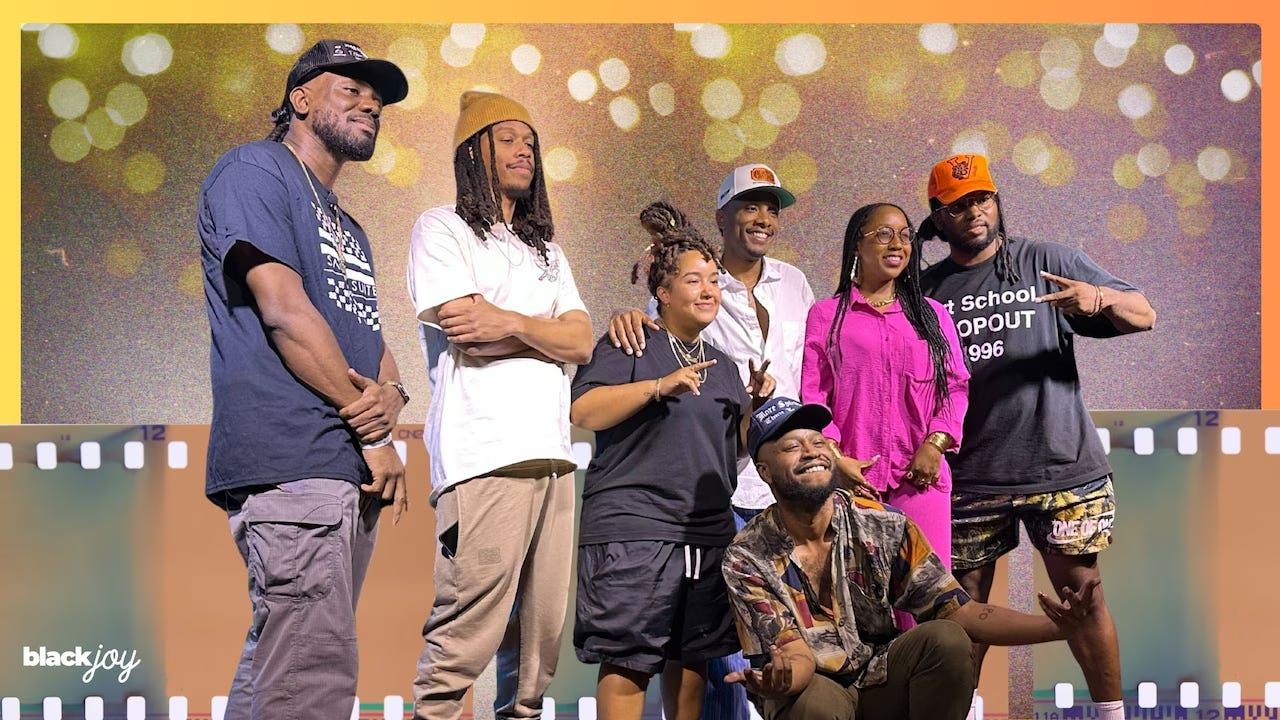
As the afternoon turned to dusk, attendees gathered in front of the Woodlawn Theatre stage for Vibrantalks, which was a candid panel discussion with Alabama filmmakers and producers. Glaude and Taylor joined three more creatives: Vibrantake founder Clyde Foster Jr., also known as “Uncle See’J,” co-produced and was heavily featured on the soundtrack for “They Cloned Tyrone.” Lebaron “LB” Thornton, a Southern-based filmmaker and music artist whose single “Socks N Slides” helped build the world of “They Cloned Tyrone,” and Birmingham-born rapper, producer and author You Gene Write.
Seated side-by-side in directors’ chairs, the panelists discussed how the media’s monolithic portrayal of the South, which is often rooted in its racial trauma, overshadows the cultural richness of the region. Along with the movement work that has led to the enactment of the nation’s civil rights laws and voting rights, many Southerners also forged the healing harmonies of the gospel, the storytelling of the blues and jazz, the soul of rock and roll and Southern the hip hop beats. Thornton said Vibrantake sharpens the storytelling skills of Alabama artists by building a stronger community.
“I think I can speak for all of us when I say, as young artists, there was support that we were missing in the state,” Thornton said. “We are looking to create that space by doing events, by helping people make music, by collaborating with people.”
These conversations are occurring at a vital time for Black entertainment. Producer Issa Rae and other media leaders have talked about the string of cancellations of Black-led shows such as “Lovecraft Country,” “The Wonder Years,” and “Rap Sh!t.” An associate editor from Essence referred to the cancellations as acts of cultural erasure. Both Alabama Values and Vibrantake believe more Southerners need to be in more director’s chairs and writing rooms so they can tell the truth of their own Southern experiences.
During the nearly two-hour panel, You Gene Write and the creatives discussed Black, Southern representation in music and TV, what they are doing to fill that gap and how they put a little piece of Alabama and Southern culture into their work. Here are some takeaways, edited for clarity:
You Gene Write: Let’s have an origin story. What’s the first Southern Story that made you feel seen and how does that energy show up in your work?
Glaude: It took a long time for me to be seen in a movie. It actually wasn’t a Southern movie. It was “Pariah” by Dee Rees. The code-switching, the living of two different lives – I experienced a lot of that growing up, in southern Alabama.
So I’m just trying to make the stories that I want to see and that I haven’t seen in places that I haven’t seen myself. Because truth be told, I haven’t seen nobody like me on film, you feel me? You dig? So, I say that to say we have a long way to go. I’m sure there’s a lot of stuff out there where people feel seen regardless of their race, creed, blah, blah, or whatever. But as far as me, I feel like we got a little ways to get there. Shout out to the people who are also doing work.
Taylor: The first thing that even comes to mind is not even a film. It’s music stuff. As a kid, seeing [hip hop duo] 8Ball & MJG and OutKast not compartmentalize rap to somewhere else, I thought that was hard. That was a completely non-film related answer, but those were the first Southerners who I can remember.
And then, some homegrown heroes [from Alabama]: Dirty Boyz. The “Rollin Vogues” video. When I saw the Rollin Vogues video, I was like ‘oh, this me.’ They had the alligators on strings. I thought that was huge out in the Gump.
Thornton: For me, it was the show “Atlanta.” That should tell you how long it took. A lot of the Southern narratives were based in our bloody history, but ‘Atlanta’ was kind of like Seinfeld for young Black people. It was a show about nothing. That was super smart and it engaged me in a way that I’d never seen anything else. I think I was 30 or 28 years old when “Atlanta” dropped. So it took 28 years for me to feel like ‘Oh wow, this really represents me.’
You Gene Write: What do you guys think is missing from mainstream stories about the South and how do you balance honoring the tradition with something that feels new, now and true to you? How do you fill in those gaps in your current profession?
Thornton: The modern South is not the South of the past. Look at what the South is. I’ll give you an example. I left a movie once. I was a production assistant on it. I was told it was one thing: It was a slave movie. I didn’t want to work on it. I told myself I’d never work on another one again. Saying all that to say, that’s one way I separate myself from it.
I also find it by organizing, sitting with my peers, bringing my family in and putting a room together where there are hopefully a lot of other young people out here who want to do the same things and connect in that. Just being a part of the community and developing community. Also writing and pitching my own stories. It’s not a secret. In Black Hollywood that’s been the recipe forever. You’ve gotta write yourself in. I’ll be behind the camera forever if I don’t write myself in.
Foster: I think a lot of times, it’s kind of like trauma porn. Something like that is not going to have nuance. If there’s never another slave movie made, it won’t be too soon. Or just, there are a lot of people who try and tell Southern stories but don’t understand Southern culture for real and that shows up in a lack of nuance.
I think the way to change that is to empower creatives from the South. As somebody who has lived in various places now, it was never an issue of talent or these people being particularly more talented than the people I knew back home. It was usually the opposite. Like, frustratingly the opposite. Man, I knew people at the crib about 10 times better than this. So, to be able to empower and educate creatives who are actually from the mud. I think that would do a lot of good.
You Gene Write: I’m gonna switch it up and go to ‘Shooter’ [Glaude] because you have a catalogue of actual Southern creativity. You talk about ‘Queen Sugar.’ You talk about ‘P Valley.’ That was Southern like I ain’t never seen. What are your non-negotiables to making sure that you hold true to your Southern roots within your creativity?
Glaude: I feel like what’s missing from our stories is just us making them, us being in charge of it and us being the tastemakers, the facilitators and having the say-so and stuff like that. So, for me, that’s a big part of it. You have to go in there and have that confidence and just show up as you are and trust that they’re going to vibe with it. Either you subscribe to it, or you unsubscribe to it. It’s no in between, and most people will subscribe to it because it’s different, it’s fresh and it’s organic. They rock with it. But I just try to go in there and have fun and put my spin on it.
So we get to name stuff after our ancestors and elders if we can. If we have the jurisdiction. Ava [DuVernay] does that. She’ll name stuff after her mom. So, just any of those little moments, like what the food is gonna be on the table. It could be little stuff, but over time, it builds up as we have more jurisdiction on creating our own stories and being able to tell them.
You Gene Write: Being from Alabama has helped mold the creative sensibilities of us all. How is that being reflected in your work? Is it something you do intentionally or does it happen naturally?
You Gene Write [answering his own question]: My obsession for rap led me to all these other things. It’s natural at this point if it’s something that’s going to help me improve my craft and my talent. But I think it’s natural because I’m comfortable in my obsession as an adult. I know when I wake up in the morning, this is what I’m trying to do.
Being from Alabama has molded that. But also knowing, at this point in my career, touring with these guys and going abroad. It’s like ‘oh, we can get spoiled because it’s local and accessible.’ But when I go to these other places and they’re doing shows at the rec center or in a barber shop, it makes me realize we actually have talent. We have an ecosystem. We have a community. Being from here, it actually lets me know we have something to offer to the world and we have A1, top-tier talent around me at all times. So it’s natural that I want to give my best to the people that are around me.
Taylor: It depends on the project. Sometimes, you naturally do it. But with something like ‘Tyrone,’ that just naturally comes from who you choose to collaborate with: the music. People you choose to put in it. You really just try to make something you feel like to your friends, when you go back home, they’ll actually enjoy it. I think in the back of my mind, I’m like ‘If I went back home, would they like it if they saw it?’ That’s kind of like the barometer for that.
A lot of times, it can be a little more small in the details, depending on what the project is. You might be working on something that’s set in another country. But even when you’re not consciously doing it, it’s kind of hard for some parts of it not to sneak in your work. But for something like ‘Tyrone,’ it was very intentional.
Foster: I had no choice about being soulful. Being from here. There was a time where there was a real chip on my shoulder on some rap sh*t. When I moved to New York, I was like “I’m gonna be liver than all these New York ni**as.” And I’m from Alabama. That was one of the things I wanted to make sure was known. At this point, speaking to what Ciara was saying. You kind of are who you are. And it’s gonna bleed out whether you want it to or not.